Friday, April 6, 2012

Cha guor - Hakka Tea Cake - 茶果

I recently learnt how to make cha gwo from Ice a friend of mine who lives in Tuen Mun.  Angel, another friend, and I travelled together from Tsim Sha Tsui East to the North-West New-Territories. It was the first time for me to take the West Rail Line of the MTR up to Tuen Mun and also the first time to take the Light Rail Transit. Although I heard a lot about the LRT when it started operation in 1988 I had never had the opportunity to take it before not until that day (when I went to Ice’s home).
Anyway, let’s go back to learning how to make cha gwo!

Tuen Mun Promenade (Far away): Tuen Mun Ferry Pier


Cha guor or chàah-gwó in Cantonese (literally means: tea - fruit) is a Hakka dessert made of glutinous rice and stuffed with a savoury or sweet filling. There are no tea leaves in the preparation of cha gwo contrary to what I first thought. Ice was not sure of the origin of the name but said people like eating this sticky pastry while sipping tea, hence its name.

Tea cakes - chàah-gwo2 - 茶果 


Note: The ratio of glutinous rice flour ( 糯米noh-máih) to wheat flour is 3 to 1.

Ingredients:

For dough:
  • 120gr glutinous rice
  • 40gr wheat white flour
  • About ½ cup of boiling water
  • About 1 Tbsp vegetable oil (grape seed) + extra (for greasing leaves and top of cakes)

Equipment:
  • Wok, steaming rack, and a round metal disc with holes (or a steamer pot).
  • Banana leaves (washed, dried and cut into circular shapes).

Ice had prepared for us 3 different fillings the day before:
  1. A mixture of dried shrimps, dried Chinese mushrooms, shredded turnip, and seasoning (in particular rice wine and crystal rock sugar - called bìng-tòhng in Cantonese). I recall that Noel also told me that crystal rock sugar goes very well with turnip – click here to read my post on Noel's turnip cake
  2. A mixture of mashed mung beans and peanuts, and
  3. A red bean paste {with a lovely a tangerine peel after taste}.
Steps:
  1. Dough: In a large mixing bowl combine the 2 kinds of flour. Pour gradually the boiling water stirring constantly with chopsticks until large crumbs form. Add vegetable oil and knead with your fingers until dough sticks together and forms a ball.
  2. Rice cakes: Flour your hands. Take a small ball of dough and roll it in flour. Press down with your thumb to make a well in the centre of the ball.  Put a little bit of flour in the well. Press gently the dough between your thumb and forefinger turning constantly until a small cup is formed.
Note: The smaller the ball of dough the easier it is to make a nice rice cake.

Shaping the dough ball with your fingers

Filling no.1: Turnip, dried mushrooms & dried shrimps
Closing the edges
Spoon some filling into the cup. Use your thumb and forefinger to slowly pinch the edges closed.
Filling no.2: Mashed mung bean & peanuts

Filling no.3: (Left) Red bean paste. (Right) Red bean (for garnish)
Place each rice cake on slightly greased banana leaf rounds (use vegetable oil and a brush). Arrange the rice cakes on a single layer on the steaming disc (or steamer basket). Fill the wok about half full of water and bring the water to a boil. Place metal disc with rice cakes on the steaming rack, cover and steam for about 8 minutes. Note: Steaming time depends on the thickness of the dough.

Rice cakes arranged on banana leaf rounds
Open lid and poke a hole in each rice cake with a toothpick (to let steam goes out). Close lid and steam for another minute. Open lid and lightly brush with oil each rice cake. Close lid and cook for another minute. Turn off heat and remove meal disc from wok. Serve rice cakes hot or warm.

Cooked Hakka rice cakes (note the alien shape on the left!)
My favourite rice cakes were those with the mung bean and peanut filling. Ice explained me how to make the mixture. I will first practice at home and give the recipe later in another post.

Miam Miam / Yummy / Hóu-hóu-sihk
View from Tuen Mun Promenade

Magnolia blooming in Tuen Mun

 Thank you Ice!  謝謝冰玉! :)


Thursday, March 29, 2012

Salted Myrobalans & Chinese Olives

I recently discovered a fruit which looks like an unripe mirabelle plum or a large gooseberry. I found it at a stall selling medicinal herbs and plants.

As usual, I asked the seller:
“What do you call it?”
R: ”yàuh-gâm-jí”.
“How to write it?”
R: “ 油甘子”.
Fresh myrobalans

Wednesday, March 21, 2012

Pork, Bamboo Shoot and Tianjin Preserved Vegetable Stew

Before coming to Hong Kong my favourite pickle was gherkins. I love the crisp and sour taste of these baby cucumbers preserved in white vinegar with dill, mustard seeds, pearl onions, etc. When I think of cornichons I immediately picture in my mind a saucisson and of course a fresh baguette! {I suddenly feel hungry!}

Stall selling preserved produce
Mongkok (Canton Road)

Here in Hong Kong I discovered many kinds of pickles. Chinese people not only pickle cucumbers but also fruits and greens’ roots and leaves to flavour their dishes. Radish, stem lettuce, Chinese artichoke (a root vegetable that looks like sea shell) and Swatow mustard greens pickles are commonly sold (in glass jars) in supermarkets and Chinese grocery stores. They are also sold loose (unpackaged) by weight at the wet market.

Chinese artichokes (pagoda vegetable - bóu-taap-choi- 宝塔菜)
Also called stachys affinis

While some vegetables are preserved in brine (salted types) and others in vinegar (sour types) some have been salted and underwent different fermentation processes. Over the years here in Hong Kong I took a liking to Chinese pickles. Here are 3 of my favourites:

Wednesday, March 14, 2012

5-Colour Burdock Root Soup

I have often seen burdock root either at the supermarket or wet market and I have tried it before in soups at restaurant but I have never bought burdock to cook for myself (until recently).

The root of the young burdock plant or ngàuh-bóng in Cantonese (牛蒡) looks like wooden sticks. It is rich in fibre and low in calories.

Burdock root / Ngàuh-bóng / 牛蒡

Saturday, March 10, 2012

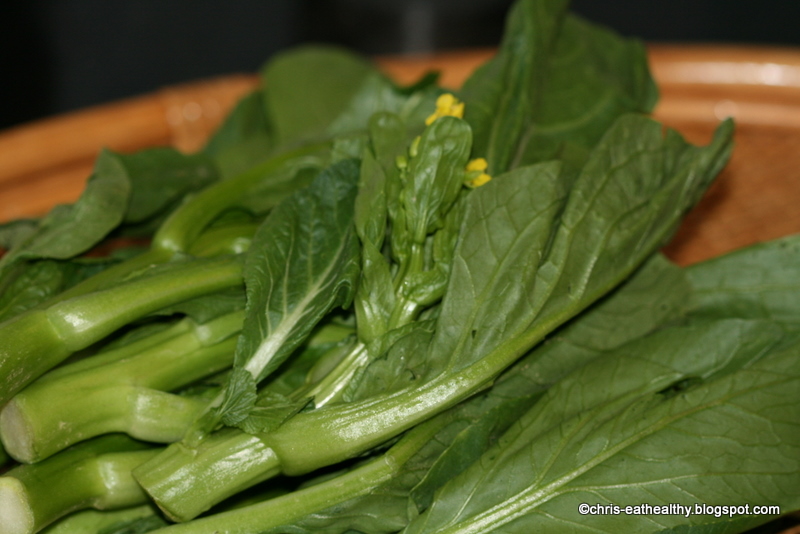
Silver silk and red flowering Chinese cabbage

Last week I bought 2 “new” vegetables. Actually there were not really “new” but variants of the Chinese flowering cabbage.
Chinese flowering cabbage is the most common local leafy vegetable and you can find it almost all year round.

Flowering Chinese cabbage / choi-sâm / 菜心 (vegetable – centre/heart)


At the beginning of the week I saw a red colour flowering Chinese cabbage at one of my favourite stalls in Mongkok.


Red flowering Chinese cabbage – hùnhg-choi-sâm - 红菜心

Similarly to yard long beans or eyebrow beans which come in green and purple, there is also a purple version (red in Chinese) of flowering Chinese cabbage.  Its stems are purple, its leaves a nice bluish-purple but its tiny flowers are of the same yellow colour as its green cousin.


It cost much more than the ordinary green type ($28/catty* versus $10-12/catty) but I liked the lovely colour and thought it would be nice to have a colourful dish on the table that evening.

I simply boiled the red flowering Chinese cabbage in salted water for a few minutes with garlic and served it with a dash of oyster sauce on top. However the vegetable turned green after cooking and, as you have guessed, the water turned red. I suddenly recalled that the purple yard long beans that I had bought last summer at the same stall had also turned green after cooking. I should have known better. But wait…I remember that the purple eyebrow beans had kept its nice colour!
In my disappointment I forgot to take a photo! 

I found the taste of the red variety sweeter than the green but not worth the price difference.  

* 1 catty (一斤 - yât-gàn ) equals ~600 grams.

A few days later while doing my market in Tai Po I found another veggie which had the same yellow flowers as the flowering Chinese cabbage but had yellowish green big curly leaves and large white stems.

Silver silk flowering Chinese cabbage - ngàhn-sî-choi-sâm - 银絲菜心
After asking the seller the latter told me that indeed it was another variety of flowering Chinese cabbage and its name was ngàhn-sî-choi-sâm - 银絲菜心 (silver-silk-vegetable-heart).
I paid HK$14 for one catty, which is slightly more than for the green type but still cheaper than the red type bought at Mongkok a few days before.

I cooked the silver-silk exactly the same way as the red variety, i.e. boiled and served with a dash of oyster sauce. It tasted more like Savoy cabbage and not that much like flowering Chinese cabbage (choi-sâm –菜心).


Boiled silver silk flowering Chinese cabbage with oyster sauce
Verdict: I was pleased with the latest vegetable I found. I am not a big fan of choi-sâm but liked the silver silk variety very much and would not mind buying it again. As for the red (purple) cousin I’d rather look at its attractive colour at the wet market (in its raw form).


Wednesday, March 7, 2012

Cheung Chau: Fish Balls, Seafood and But-jái-gôu

Last week I went with some of my friends to Cheung Chau. I used to go there almost every week-end during my first 3-4 years in Hong Kong. That was before our son was born. We loved the quiet pace of this small island, its beach and fresh seafood.  So this trip was full of nostalgia.


We started our ½ hour journey by ferry by eating snacks brought by Jane, a Taiwanese lady, who treated us with roasted peanuts with purple skin - delicious - and vegetarian mock beef tendons. The jelly like pieces had a subtle Chinese star anise flavour. Quite good!

Upon arrival to the small island we were greeted by one of Florence’s  cousin good friends, who is from Cheung Chau. Lorraine kindly guided us around the island during the day.

She first brought us to Kam Wing Tai Fish Ball Shop {甘永泰鱼蛋 gâm-wíhng-taai yùh-daahn} as some of us wanted to order fish balls to bring home (to be picked up in the afternoon). There we indulged ourselves in piping hot fish balls, meat balls and mixed balls. The squid and pork balls were delicious!

Squid & pork balls, fish cakes and bean curd puffs (front)

Bean curd puffs (dauh-bûk 豆卜) with minced fish skewer (left)

Beef, fish, squid & pork skewer
Then we started our walk around the island. Before reaching the beach we stopped at Sun Chiu Kee Tea Food Snack Shop (新照记茶餐小食店 - sân-jiu-gei chaàh-châan-siú-sihk-dim). This shop sells tea eggs, ping-pong fish balls, steamed white sugar cake (白糖糕 - baahk-tòhng-gôu), salty tea dumplings (咸茶- hàahm-chàah-goû), steamed red bean cake, and many other snacks.

Steamed puddings and other snacks 
I returned to the shop with Christina in the afternoon to buy some red bean cakes to bring home.  Actually my friend Christina bought them for me.  Thanks Christina! The red bean cake is the one you see on the left -  above photo - in a large round tin, with a golden top.
The small ceramic bowls you see on the right are but-jái-gôu (缽子糕, which means: small earthenware bowl or monk’s alms bowl - cake). But-jái-gôu used to be a very popular dessert sold by hawkers. It is made with glutinous rice, sugar, coconut milk and red beans. I had tried it many years ago but did not like it that much. I found it too sticky. I prefer the red bean cake. It is not too sweet and the texture is soft and creamy. The coconut milk-flavoured coating is also delicious. So yummy! I wish I could have some more right now.

The big slice of red bean cake partly eaten ;)

But-jái-gôu is turned out of the bowl and
served on a wooden skewer
We continued our walk. It was just the right time to see the cherry blossoms. Many photographers were taking pictures of the beautiful red tree standing in front of the Kwan Kung Pavilion [gwàan-gùng-jùng-yih-tìnhg - 關公忠義亭].

Cherry blossoms


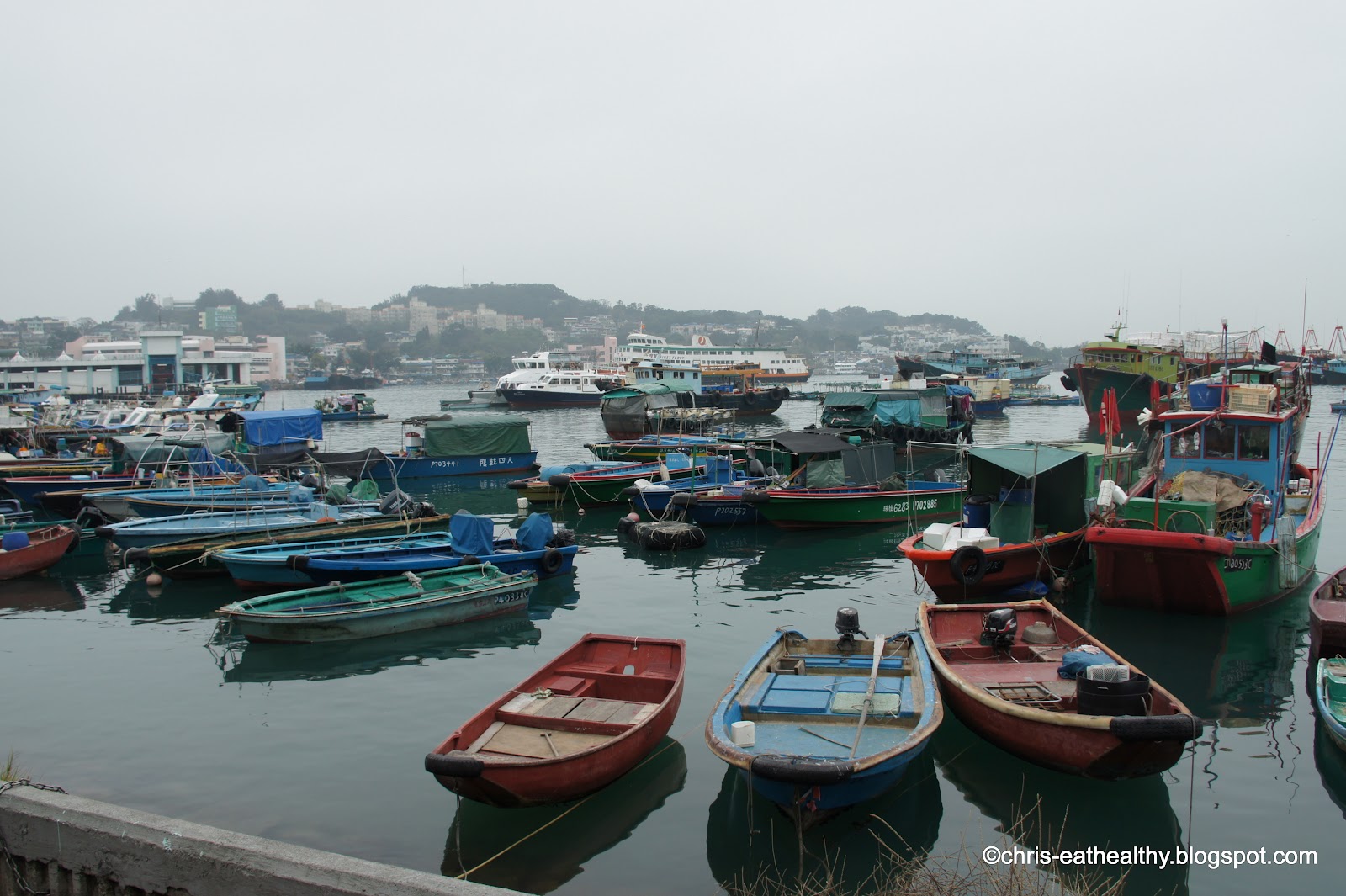
Then Florence and Rita went ahead and bought live fish and seafood for all of us (2 tables) at the wet market. They chose to have the fresh produce cooked by Hung Lok Seafood restaurant 恒乐海鲜茶馆-hàhng-lohk-hói-sìn-chàah-gún (13B, Pak She Praya Road). We ate on the waterfront promenade, some of us looking at the many boats moored in the bay and the others (those sitting on the other side of the table) the activities of the street.

Boats moored in the bay

Below are the photos of our dishes:

Poached shrimps - baahk-cheuk-hâ 白灼虾

Stir-fried clams in black bean sauce

 Braised bean curd with Shanghai white cabbage
Stir-fried Chinese lettuce

Steamed fish

Water spinach with preserved bean curd

Wok-fried lobster on crispy egg noodles

Sweet and sour pork ribs

Deep-fried fish with peppered salt

The fish was very big and prepared into 2 dishes: the thick fillets were deep fried with pepper and salt, while the remaining part of the fish was steamed with ginger and spring onion.
We also had a soup (soup of the day) but I did not take a photo as its colour was not very attractive.
The whole meal was washed down with cool beers. What a delicious meal!

After this feast some of us wanted to try the famous desserts of Wan Shing Dessert Shop (允升甜品-wáhn-sîng tìhm-bán).  They have an extensive choice of sweets and drinks but the most popular items are certainly their mango sticky rice cakes/mochi (芒果糯米糍 - mòhng-gwó noh-máih-chìh) and mango rice rolls - mòhng-gwó cheùhng-fán – 芒果肠粉 (mango-intestine-noodles). 


Mango mochi

Black sesame mango rice roll / Mango rice roll (white roll)
Sonja bought some mango mochi and mango rice rolls. I tried a little bit of both. I will not give any comments as I don’t really like mango and furthermore I was too full to really appreciate them.

Afterwards we took a short walk in the town centre.  I bought dried silver fish to make one of my favourite dishes: Tai-O style steamed eggplants.


Buns stamped with the 2 red characters 平安 meaning peace (pìnhg-ngòn)

We finally stopped at Kwok Kam Kee Cake Shop (郭锦记饼家- gwok-gám-gei béng-jiâ) which makes traditional cakes and “peace buns”.
There I bought a large bread-like biscuit - 光酥饼- gwòng-sôu-béng (light/bright-crisp pastry-cake) to go with my morning coffee the following day. It was not too sweet and I liked its light texture but the pastry was a bit too gluey and stuck in my teeth.


Before going to the pier we went back to our first stop to pick up the fish balls ordered in the morning.
On the ferry Jeany, who might have thought we were still hungry (hahaha), gave each one of us a "sugar spring onion cookie" (tòhng-chûng-béng - 糖葱餠). This kind of crepe looks like the white part of the spring onion. Its cononut and sesame filling is wrapped in a very thin and crispy rice sheet.  Although I was more than full she insisted and I had to try her kind treat.

Sugar-spring onion-cookie" (tòhng-chûng-béng - 糖葱餠)

This fluffy pancake was good but far too sweet for my liking.


It was a great and enjoyable day.
Good food and good company.
To all my friends: Thank You!
Let’s plan another trip soon!