Tuesday, August 9, 2011

Oxtail in Mexican Mole Sauce

After reading Eda’s recipe called Ancho Pancetta Oxtail Mole (see locavore-project-part-2 ) on her website (www.edamame-eats.com) I could not resist but try to make it. I love ox tail and the addition of chocolate in a savoury dish attracted me.
So, last Saturday I went to the supermarket to get all the required ingredients and in the afternoon prepared my version of Eda’s Ancho Pancetta Oxtail Mole.
I was so pleased with the result that I thanked Eda for sharing her great recipe and asked her if she would not mind if I posted a variation of her dish on my blog. As she kindly accepted I am glad to share it with you today.
Believe me it is worth trying and most of all eating it!!!

Ingredients:
  • 80g smoked pancetta
  • 2 small carrots (diced)
  • 1 large celery stalk (diced)
  • ½ orange onion (diced)
  • 3 small red chile (chopped, with seeds)
  • 55cl red wine
  • 125ml broth (125ml water mixed with ½ cube of organic vegetable stock). I did not use beef stock as I did not have time to make my own)
  • 600g oxtails (separated joints)
  • Salt & ground black pepper
  • ½ can of tomatoes
  • 1 tbsp tomato purée
  • ½ tsp cumin
  • ½ tsp oregano  
  • 12g dark chocolate (no added sugar) 
  • Parsley to garnish

Steps:
  1. In a saucepan I browned the pancetta then added celery, carrot, onion and chile, and continued browning everything for about 10 minutes.
  2. I added the red wine and turned up the heat to let the wine reduce. Then, I transferred the mixture in a bowl.
  3. After sprinkling salt and black pepper on ox tail I added 2 tbsp olive oil in same saucepan and browned the ox tail. Them I transferred the ox tail to the bowl with veggie/pancetta mixture.
  4. I lowered the heat and in the same saucepan I added the tomatoes, oregano, cumin and chocolate. I stirred well all the ingredients and added the tomato purée. 
  5. Afterwards I transferred the ox tail and the veggie/pancetta mixture into the saucepan and covered everything with the vegetable broth.
  6. I cooked the ox tail on low heat for 2 hours (with heat diffuser plate under flame) mixing occasionally.
Below is the photo of the finished dish served with penne rigate. I am afraid that my picture doesn’t give enough credits to the flavour of this delicacy.


The ox tail meat was well cooked and flaked off the bones. The chocolate/chilli-flavoured sauce has a spicy flavour with a sweet aftertaste. So yummy! My husband and I cleaned our plates!

In some aspects (its rich flavour, consistency and wine taste) the Mexican mole sauce reminded me of the rabbit stew’s red wine sauce (civet de lapin) I had when I was small. I recall that my Mum usually serves rabbit stew with a creamy polenta. Next time I make this dish I will also prepare a savoury (or sweet) polenta cake or maybe some potato gnocchi to go with it (is my Italian blood showing? ;)


Notes:
- Mole is the name for many Mexican sauces. They are usually made with one or several types of chiles, spices and chocolate
- Ancho chile is another name for poblano pepper.

Friday, August 5, 2011

French outdoor market


It has been a long time since my last post. It is not that I did not have anything to share but I have been away for almost 3 weeks and did not find time to write.  I know that I don’t have any pressure (my blog having no commercial purpose) but recognize that I have been neglecting my followers and ask them (you) to accept my apologies.

I spent a few days in London, almost a week in France (to visit my parents) and finally a long week-end in Taiwan. A lot to discover, to visit and of course to eat!

During my stay in France I went to the wet market. Going to the Saturday market has become a pilgrimage. Each time I return to my hometown I have to “faire le marché” – shop at the market. This weekly market is held in the city centre, and each Saturday from 6:00am to 1:00pm the heart of the town turns into a pedestrian mall. Not only do I go there to buy food but also to take pictures and chat with my old friends. Vienne is a small town but its Saturday market attracts lots of people from the surrounding villages. This is the place where you are bound to meet friends and distant relatives and hear folks exchanging news and gossiping. 

I particularly like the stalls selling vegetables and fruit as well as the rotisserie (with its spit-roasted chicken) and the olives vendor.


Vegetables / Fruit:  An array of colours!


At this time of the year musk melon (cantaloupe, from Spain and France), apricots, peaches and nectarines are everywhere.


Yellow and green courgettes (Italian squash/zucchini), cucumbers, tomatoes, and bell pepper are also in abundant supply.


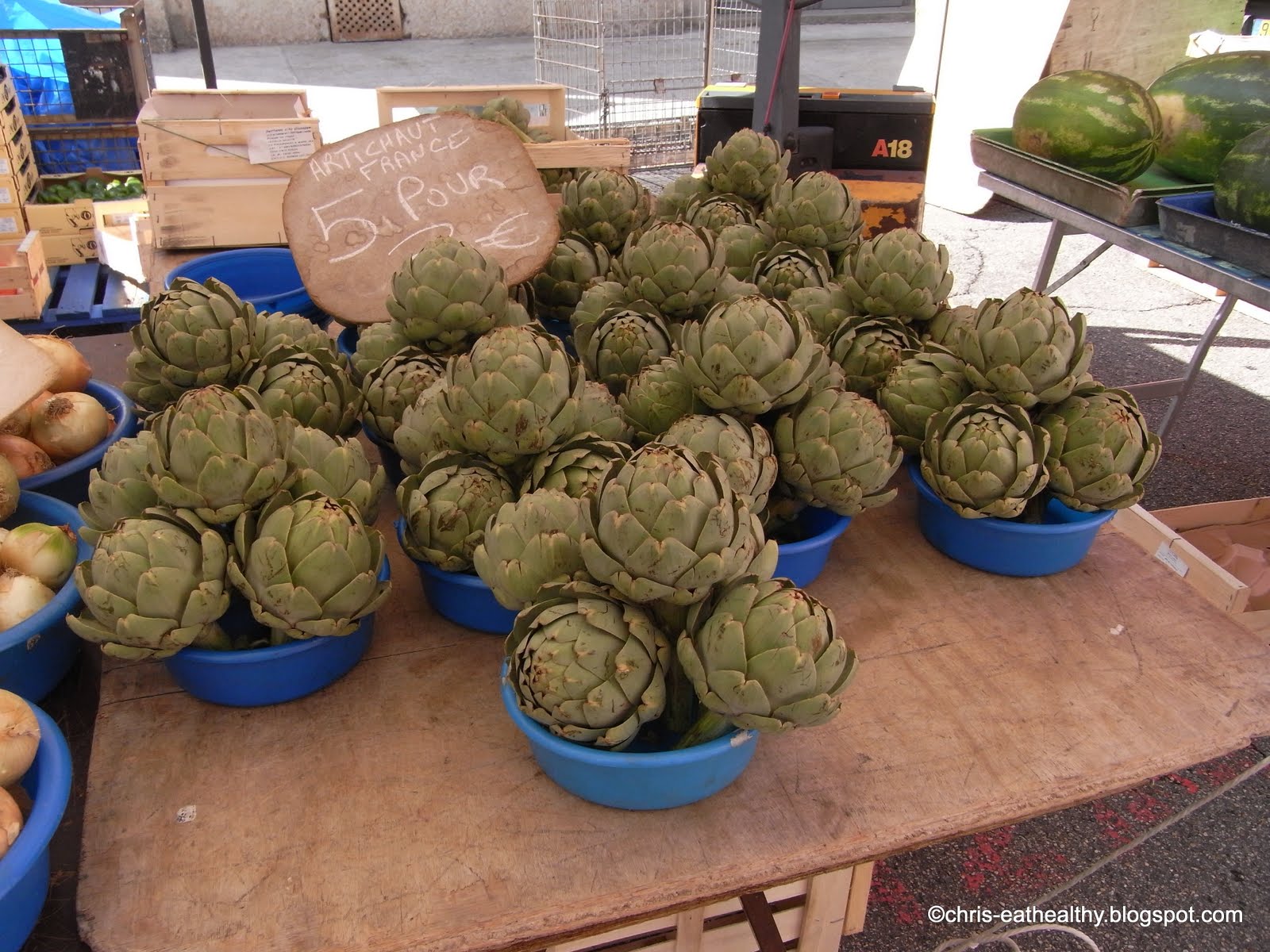
Artichokes (I love artichoke!)


Rotisserie: Roasted chicken (poulet rôti)!

During a normal summer day the sun is scorching hot and I don’t envy the stallholders facing the grills! On the other hand in the winter they are the luckiest and their customers are happy to queue up so they can warm up before continuing with their shopping.  No matter the season there are always people waiting to be served. On the day I was there the weather was pretty cool for a summer day and the scent of roasting chicken kept attracting folks to their stall.


Just by looking at these juicy chicken I can still smell their aromatic herbs aroma.


For a few extra € you can get grilled potatoes with chicken gravy.

Next to the rotisserie chicken stall is the olives vendor.


Oil / Olives / Tapenade / Anchoïade / Pissaladière:

Like most of the booth holders the owners of this stall have been selling their goods each Saturday for the past 30 years. At their place you can find excellent cured and marinated olives as well as other Mediterranean food products such as tapenade (spread made with olive, garlic, capers and anchovies), dried tomatoes, preserved lemons (for tajines and other Moroccan dishes), lupin beans in brine, anchoïades (anchovy purée/spread), anchovies marinated in oil, garlic and parsley, olive oil and pissaladière (onion tart with olives, anchovies and herbs).


Olives are presented in large baskets covered with plastic wraps and come from Italy (Sicilian style), Spain (Andalusia - Seville), Greece (Greek-style) and France (Escabèche [marinated with olive oil, vinegar and smoked paprika], Niçoises [very small black olives from Nice], etc.).

I enjoy tasting olives before choosing a variety.  During the past few years my favourite type of olive has remained the Greek style. They are really delicious!                                   


A few streets away from the city centre and far away from the hubbub of the market activities I find calmness walking through the small alleys on my way home with a basket full of fresh produces.   

Friday, July 15, 2011

Wholemeal Bread with Oatmeal


I love bread. Sometimes I miss freshly-baked bread. Have you ever passed in front of a bakery very early in the morning?  Oh, what a lovely smell! Actually I prefer bread rather than cakes. Really! (if the bread is good, bien sûr!) I definitely acquired a taste for bread when I was small.

In France, bread is not only an accompaniment to meals and served at breakfast with croissants and jam but also (was?) a good treat as kids’ afternoon snack /le goûter. My Mum used to give my siblings and I a slice of bread with a chocolate or crystallized fruit bar to eat during school breaks. I bet most of the kids now have more elaborate snacks?!

Bread is indispensable for people living in the country or doing manual jobs. My grand-father was a postman and would set off very early on his rounds and cycle no less than 40kms per day to deliver the mails to the 3 surrounding villages. At 9am he would take a break and eat some food. I remember seeing him preparing his morning snack /casse-croûte, which consisted of bread and cold smoked pork belly. He was one of these men who would never leave home without his French beret on his head and his pocket-knife on him! However, he never carried a baguette under his arm but in the side pannier of his motorized bike!

As it is difficult to keep baguettes with the humidity in Hong Kong I bake my own bread and I store it in a plastic box in the fridge. It stays fresh for at least one week.  Each morning I enjoy a slice of toast with my cup of coffee.

Here is my recipe:

Wholemeal Bread with Oatmeal
Ingredients:
  • 375 g wholemeal flour
  • 50 g oatmeal
  • 1 tsp baking soda
  • ½ tsp salt
  • 300 ml low-fat milk
Steps:
1.      Preheat oven at gas mark no.6 / 230 ºC.
2.      In a bowl combine the flour, oatmeal, soda and salt.
3.      Make a well in the centre and slowly work in the milk to form a ball.
4.      Place the dough on a floured board and knead it for 5 minutes.
5.      Shape the dough into a flat round loaf and place on a greased baking sheet. Draw a cross with a sharp knife on top of the bread.
6.      Bake 15 minutes at 230 ºC. Reduce the heat to gas no.5 / 200ºC and bake 30 minutes longer or until golden.
7.      Wrap the bread in a cloth towel and leave to cool on a wire rack.


Note: I sometimes put pumpkin seeds and/or Goji berries in and also 1 tbsp of ground flax seeds.


Bon appétit!

Tuesday, July 12, 2011

Mouse Melon Stir-Fry

I found this cute-looking gourd at my usual stall in Mongkok. The middled-age man and the old lady (I guess Mum & Son) are always very kind to me. I know that it must be annoying to answer all the foreigner's (gwái-pòh!) questions. Not only do I ask the name of their produces, how to cook them, but also how to write the name in Chinese! They are so patient. And I am so lucky and thankful.

This fruit plant is called "mouse 老鼠 lóuh-syú"  melon (gwâ 瓜) due to its shape and colour which looks like the small rodent. The surface of the melon is covered by a greyish fur-like velvet.


Ingredients:
Seasoning:
  • 1 tbsp Hoisin sauce (seafood sauce)
  • 1 tsps light soya sauce
  • 1 tsps sugar
  • black pepper & salt, to taste

Note: I also added 1/2 zucchini (left-over) 

Steps:
  1. Wash clean the mouse melons.
  2. Peel and cut lenghtwise. Using a spoon scrap to remove the seeds and fibrous flesh.
  3. Cut again lengthwise and slice into 1 cm thick pieces.
  4. Wash and cut into large pieces dried bean curd and gluten meat. Pat dry with paper towel.
  5. Wash the mushrooms. Pat dry with paper towel.
  6. Heat oil in frying pan. Stir-fry bean curd and gluten until lightly brown. Set aside.
  7. In the same pan stir-fry garlic and shallot until translucent.
  8. Add mushrooms. Stir-fry for about 2 minutes.
  9. Add melon, beancurd, gluten meat and seasoning in. Mix all ingredients well (if necessary add a little bit of water)
  10. Reduce heat to low and cook until mouse melon is tender.


The taste of mouse melon is a bit similar to zucchini squash. Mouse melon flesh is firmer and greener, and it better holds its shape than fuzzy melon (hairy gourd / jit gwâ 莭瓜).  It does not have the strong hearthy flavour of the angled gourd (silk gourd 絲瓜).

I will definitely buy again this gourd and highly recommend it to you!

Saturday, July 9, 2011

Pork Ribs with Black-Eyed Beans Soup

Summer is here and with the high humidity level it is the time to drink soups with ingredients said to eliminate excess moisture from our body. Dried cowpeas (also called black-eyed beans) or 'eyebrow beans' in Cantonese are of such type. They are also rich in fibre, have a high level of potassium and a low level of sodium. All of these make it a healthy food.

Dried "eyebrow bean" / Meìh-dáu - 眉豆

Here is my pork ribs and black-eyed beans soup recipe. This is one of the most typical of Cantonese family-type soups. As for the majority of Chinese soups its preparation is very easy but you need to allow time for cooking it.
You can substitute ribs with lean pork (which I do quite often now).

Ingredients:
  • 120gr black-eyed beans
  • 300gr (1/2 catty) pork ribs
  • 2 spring onions, chopped
  • 4 slices of ginger
  • 1 tsp salt
Steps:
  1. Wash the black-eyed beans clean.
  2. Wash the pork ribs clean and scald them in boiling water.
  3. In a large pan, bring water to a boil. Put spring onions and 2 slices of ginger in to boil over high heat. Boil for 10 minutes. Remove spring onions and ginger.
  4. Add the black-eyed beans, pork ribs, and 2 more ginger slices in.
  5. Bring back to a boil over high heat.
  6. Reduce the fire to medium heat and boil for 1 ½ hours.
  7. Add salt to taste.


Bon appétit!


Friday, July 8, 2011

Stir-fried fresh “eyebrow beans” with bacon

Two days ago I bought some attractive “flat beans” at the wet market in Mongkok.  They look like the haricot mange-tout we have in France which is flat and broad with tiny peas inside. One kind is light green and quite plump while the second is flat and has light purple edges.  


The seller told me that they were called meìh-dáu in Cantonese (meaning eyebrow bean - 眉豆). My Mandarin teacher calls them “knife bean” due to their shape (刀豆 dao1dou4) or 豇豆 (jiang1dou4). According to the Chinese/English dictionary the latter name means cowpeas or black-eyed beans. I am familiar with the black-eyed beans which are dried and used in Chinese soups [see photo below]. However, are the tiny peas in the fresh pods of the same kind or do the two species share the same name?


How did I cook my 'eyebrow beans'?
I braised the first batch (the purple ones) and stir-fried the second (greener ones). I was more satisfied with the stir-frying method. Here is my recipe:

Steps:
  1. Remove any strings and bad places from beans and wash them clean.
  2. In a large saucepan, bring water to the boil. Add beans and parboil.
  3. Transfer with a slotted spoon to a colander and drain.
  4. In a pan cook 100gr bacon (diced) over medium heat until crispy and has rendered all fat. Remove from pan.
  5. Cook in same pan 1 thinly sliced shallot and 1 thinly sliced garlic clove until translucent. 
  6. Transfer beans and bacon in pan. Stir well with garlic and shallots mix.
  7. Cook for a few minutes stirring continuously.
  8. Serve hot.
This method helps better retain the green colour of the vegetable and better pleases both sight and taste than if braised {beans cooked slowly with bacon, garlic and shallots with the lid on}.


Stir-fried 'eyebrow beans'


Braised 'eyebrow beans'


If you have time let me know which method you prefer or do you use? Thanks for reading my post!

Monday, July 4, 2011

Almond Jelly and Mix Fruit

Nothing is better than a chilled fruit salad after a heavy meal or as a snack on a very hot day. This is the first and only Chinese-style dessert I make at home. This is very easy to prepare.

Ingredients:
  • 14 g agar agar
  • 8 cups water
  • ¾ cup sugar
  • 1 cup low-fat milk
  • 1 tsp almond essence
  • 1 can of fruit cocktail
  • 1 kiwi, diced
  • 1 apple, diced

Steps:

  1. Wash, soak and drain the agar agar.
  2. In a saucepan add water, sugar and agar agar and bring to a boil. Simmer over low heat until all the ingredients are dissolved. Remove the saucepan from the stove.
  3. Stir in the milk and almond essence.
  4. Filter the liquid through a sieve then leave to set.
  5. Once the almond jelly has solidified, slice it into diamond shapes.
  6. Place pieces into a bowl and pour the fruit cocktail on top.

  7. Add fresh kiwi and apple pieces. Stir well and serve chilled.


You can replace apple and kiwi with any seasonal fruit. Try it in in July with lychees and pineapple! It makes a delicious sweet combo.

For a tastier summer dessert try lychees and orange with a dash of cointreau (orange-flavoured liqueur) and a freshly squeezed lime juice. Yummy!