Edamame are locally knows as hairy beans or 毛豆 mouh-dauh (means: hair and bean). Their name (in Japanese) means “beans on branches”. They are usually consumed as a snack, simply boiled or steamed in their pods in salted water (like you would do with fresh peanuts). Then just squeeze the beans out of the pods and enjoy them either warm or cold. They are also used in Chinese cuisine. I especially like a Shanghainese dish with green soybeans, bean curd leaf and (salted) preserved mustard cabbage.
Tuesday, June 26, 2012


Tuesday, June 19, 2012
Fresh Lily Bulbs, Baahk-hahp, 百合
Did you know that the lily is not only a beautiful flower with a delicate scent but also an edible plant?
Although there are many varieties of lilies (the lily-of-the-valley with grapes of small white bells, the asphodel, the stargazer, the calla lily, etc) only a few are grown and harvested for their edible bulbs. The two most common types are the lilium lancifolium and the white trumpet lily, or lilium brownii.
 |
Fresh lily bulbs
|
You can find fresh lily bulbs in packages at the wet market and supermarket. They are grown in Lanzhou (蘭州 làahn-jàu) in Northwest China at about 3,000 meters above sea level. The fresh onion, plump and milky, can be eaten raw in cold dishes, stir-fried or in soups (savoury or sweet).
I remember the first time I tried fresh lily bulbs in a sweet soup with lotus seeds and longan (dried dragon eye fruit). I had never tasted something similar before. The sight of creamy scales in the brown sugary liquid, the crisp, fresh and slightly starchy textures as well as the delicate and unique flavours were all new to me.
 |
A pack of 3 fresh lily bulbs (HK$22)
|
Not only the frest lily bulbs are consumed but also the dried ones. The latter are also used in Traditional Chinese Medicine as they are said to relieve cough and quite a few other ailments.
Fresh daylily buds and dried daylily stems are also edible but come from another variety: the daylily or Hemerocallis fulva.
Last year at about the same period I found fresh daylily buds at the wet market and bought a small batch. I had never tasted this plant before and adapted a recipe from Northern China which includes bamboo shoots, black fungus and pork. I wanted to buy more to try again my recipe but could not find some. It makes me think that it is time to check if the stall on Argyle Street where I purchased them last year has some. They should be in season now. As for the dried daylily stems they are more popular. Every year I buy some to make Buddha's Delight before Chinese New Year for my family to enjoy during the festivities.
Silk gourd with lily bulbs, dried bean curd and black fungus stir-fry
 |
Ingredients:
- 300 g angled luffa / silk gourd
- 3 pieces dried bean curd
- 6 water chestnuts
- 10 g black fungus (see photos below)
- 3 fresh lily bulbs
- A few slices of carrot
- 4 cooked dried Chinese mushrooms
- 2 slices ginger
- 1/2 large onion
- 2 tbsp vegetable oil
Seasoning:
- ¼ tsp salt
- 1 tsp rice wine
- ¼ cup water
- 1 tbsp light soy sauce
- ½ tsp sugar
- A pinch of ground black pepper
Gravy mix:
- ½ tsp cornstarch
- 1tbsp water
- ¼ tsp dark soy sauce
1 tsp sesame oil
Steps:
- Peel and slice the angled luffa. Soak in cold water.
- Clean and slice the bean curd. Peel, rinse and slice the water chestnuts.
- Rinse, clean and remove the petals from the bulbs.
- Soak the black fungus in cold water until softened. Trim and blanch in the boiling water together with the sliced carrots. Refresh and cut the black fungus into pieces.
- Slice the mushrooms. Shred the ginger and slice the onion.
- In a large frying pan heat oil and add salt. Stir in the ginger, onion, black fungus, angled luffa, and water chestnuts to stir-fry.
- Add the mushrooms, carrots, lily bulbs and dried bean curd pieces.
- Sizzle in the wine. Pour in the seasoning and stir well.
- Add in the gravy mix to thicken the sauce.
- Add in the sesame oil; toss evenly and transfer to a dish.
 |
Stir-fry all the ingredients in the wok
|
 |
Bon appétit!
|
Black fungus or hâk-muhk-yíh in Cantonese ( 黑木耳,means: black- wood - ear) also called cloud ear (雲耳 wàhn-yíh) will expand many times once soaked in water, as shown on the photos below:


Tuesday, June 12, 2012
Bamboo Shoots - jûk-séun 竹筍
I love bamboo shoots (竹筍 - jûk-séun). I have so far tried 3 varieties: the winter, the spring and the horse hoof. I don’t know if there are any more kinds but these are the 3 types available here in Hong Kong .
From May to mid-August this is the season of the “horse hoof” called máah-taìh - 馬蹄 in Cantonese. Then from mid-August to January we have the winter bamboo shoots (冬竹筍 - dûng-jûk-séun), followed from March to end of April by the spring (春竹筍 - cheûn-jûk-séun) variety.
Friday, June 1, 2012
Pumpkin Sprouts 南瓜苗 nàahm-gwâa-miùh
Recently while at the wet market I saw greens that looked a bit like bracken fern.
The seller told me that those were not fiddleheads ferns but pumpkin sprouts (nàahm-gwâa-miùh南瓜苗) and they would only be available for a short period of time (about one month).
I had never tried this veggie before. I knew that pumpkin blossoms could be deep-fried or stuffed and baked but did not know that pumpkin sprouts were also edible. As I usually do (when I discover a “new” veggie), I asked the stallholder how to prepare it. The lady vendor told me to simply stir-fry the plant with or without meat.
Sunday, May 27, 2012
Steamed Pork Ribs with Salted Plums & Bean Paste Sauce
Steamed pork ribs with salted plums and bean paste sauce is a dish I really like. I love the sweet tenderness and juiciness of the pork ribs coupled with the slightly sour taste of the sauce. Today I love it but I remember the first time I tasted it I found the sour and sweet flavour quite peculiar.
I like to add fresh chilli as well as a spicy type of bean paste to give it a fiery taste.
 |
Steamed pork ribs with salted plums and bean paste sauce
|
Thursday, May 17, 2012
Wild Rice Shoots - Gâau-séun- 膠筍
One of the Chinese vegetables on my list that I wanted to try this year is wild rice shoot (also called water bamboo) or 膠筍 gâau-séun (glue/gum-shoot) in Cantonese or jiao1 bai2 茭白 in Mandarin.
Note: Wild rice shoot are different than bamboo shoots.
 |
Fresh wild rice shoots
|
I tried wild rice shoots in restaurants but it is only recently, for the first time, that I selected wild rice shoots from a stall at the wet market to cook at home. It is not that I had never seen this plant before – on the contrary – but for no particular reason at all I had never purchased it. What a shame. I guess it is very simple to fall in the trap of buying the most common veggies, such as Chinese flowering cabbage - choi-sam (which I don’t particularly like) or Chinese white cabbage - baahk-choi.
Now that I know that wild rice shoots are very easy to cook and delicious I will no longer ignore them and they will be included in my menus.
The seller told me that I could either steam or stir-fry the young shoots with pork slices. However once at home I decided to sauté them without adding any meat. I wanted to make a very light dish so as to taste the true flavour of the veggie.
Stir-fried wild rice shoots
 |
Stir-fried wild rice shoots
|
Ingredients:
- ~1 catty of wild rice shoots
- 1 slice ginger, crushed
- 1 red chilli, chopped
- 1 green chilli, chopped
- 1 Tbsp oyster sauce
- 1 Tbsp light soy sauce
- 2 Tbsp water
- Ground white pepper
- 2 Tbsp spring onion, chopped (garnish)
- 2 Tbsp vegetable oil (grape seed)
Steps:
- Prepare shoots. Remove outer layers (all the green part) leaving only the white flesh. Trim end. Wash, drain and cut in ½ cm lengths*.
- Heat oil in wok and add ginger, red and green chilli. Stir for 1 minute over high heat.
- Add veggie. Stir for a while, and add sauces mixed with water.
- Stir-fry for another 4-5 minutes (or until tender).
- Turn off heat. Add white pepper and chopped spring onion; mix well.
Transfer veggie to a serving plate and serve very hot.
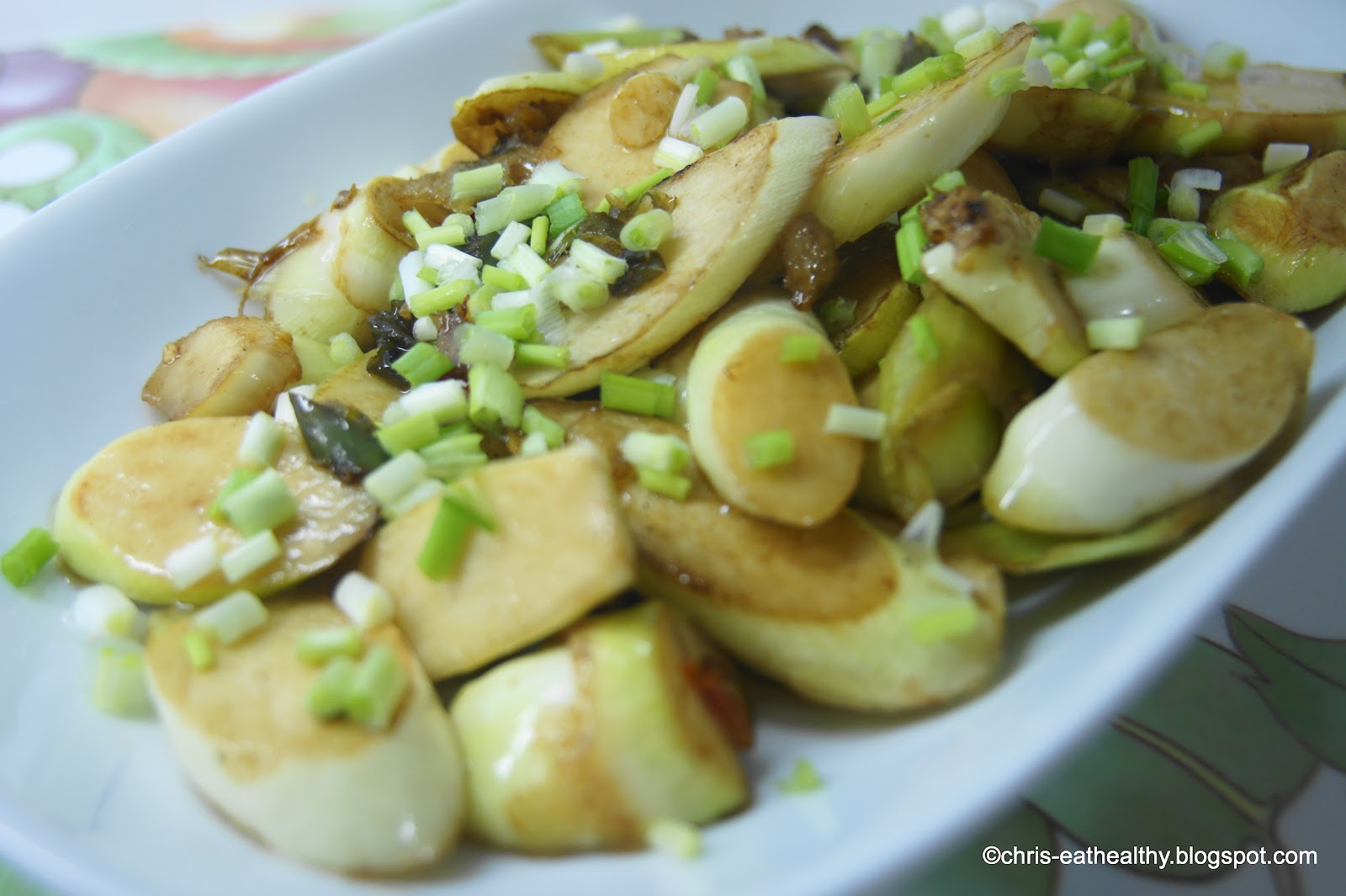 |
| Wild rice shoots sprinkled with chopped spring onion |
* I cut the stem in ½ cm lengths. In the dishes I tried before in restaurants the shoots were cut into large pieces and then in half – lengthwise – and finally sliced super thin.
I like the mild taste and the tender-crispy texture of the shoots. They are tender and blander than bamboo shoots. I have since stir-fried wild rice shoots with shredded pork. This was very tasty but I prefer the way I cooked them the first time (vegetarian style). I enjoy light dishes which get a flavour lift from chilli and ginger without overpowering the veggies.
Ah! For an even lighter dish I have yet to try to steam them!
Thursday, May 10, 2012
Bracken Fern Shoots - Kyut-choi - 蕨菜
After reading my post on Chinese vegetables Hauman (one of my friends) asked me if I had ever bought “bracken” or “wild fern shoot” before and if not to add it on my list of “vegetables to try in 2012”.
I have been looking for ferns since the beginning of the year when about 2 weeks ago I found this plant at my favourite stall at the wet market in Mongkok.
 |
| Fresh brackens |
Subscribe to:
Posts (Atom)